As someone who travels frequently, I’d long been frustrated by this: none of the map apps I use let me store and sync my place bookmarks in a way that’s interoperable across apps and works equally well on desktop and mobile — a perfect use case for remoteStorage.
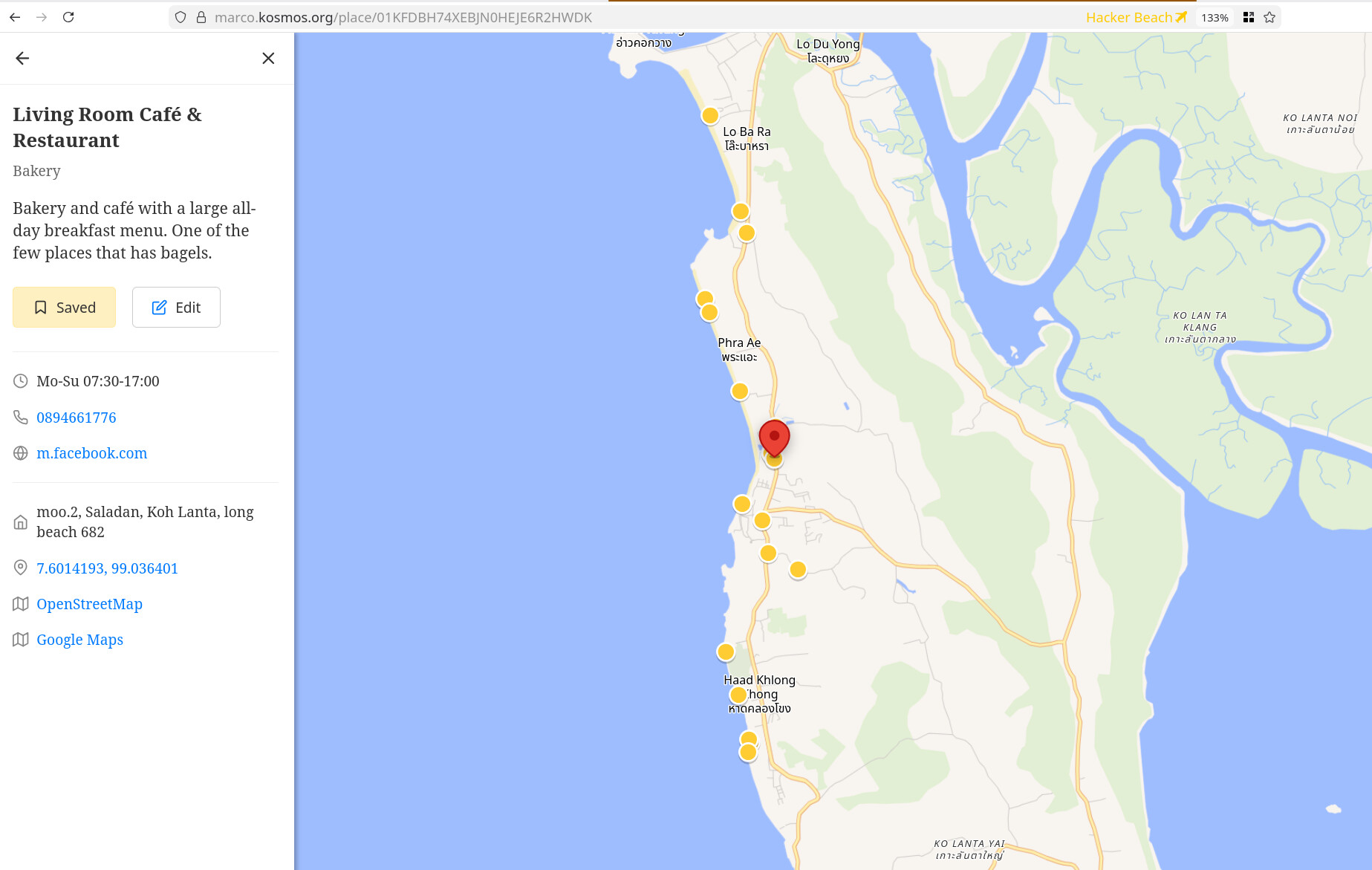
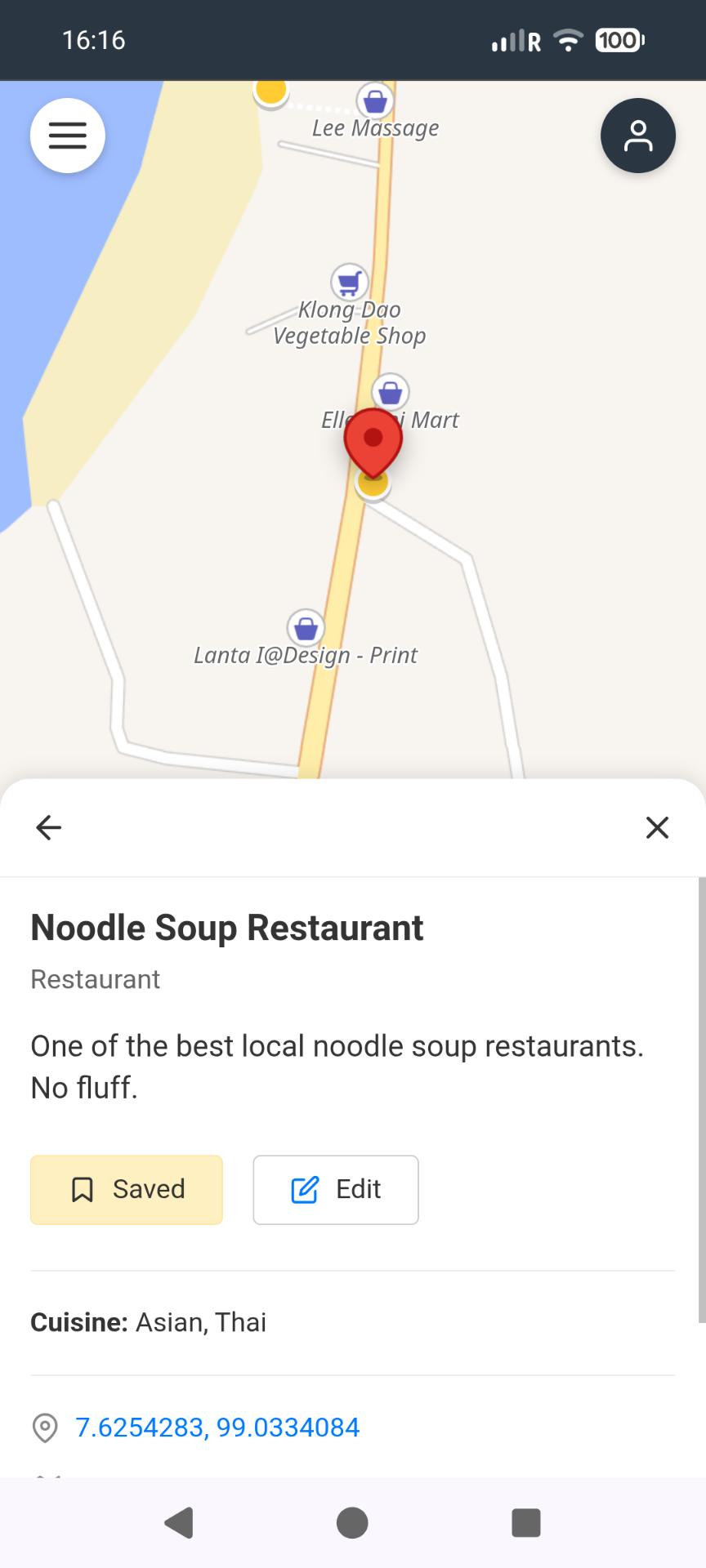
So over the last two weeks, I finally set out to scratch that itch and built Marco, an unhosted maps app for accessing and managing your favorite places.
I also published a new places data module, so other apps and automations can read and write the same place data. The goal is to make saved locations portable, scriptable, and not locked into a single app.
POI search is based on OpenStreetMaps data, but you can add your own private places as well
The storage layout is based on geohashes, which make geographic queries possible.
The place document names/IDs are ulids, which are unique, but sortable by creation date
Current state
The initial version is focused on saving places you already know (or are currently at), while search/discovery of new places is on the roadmap for future releases.
Future plans
I’m genuinely excited about a number of potential new features for Marco. For example, place reviews that are 100% user-owned, or sharing lists of places with other people. I already added a few issues for what I think would be interesting to look at next.
However, any and all feedback is much appreciated!
Great start . I have been using Organic Maps on iOS and it works nicely but yes you can’t really have data on multiple devices yet. You might consider to link those OSM/Nostr links to their issues as an invitation for people who can contribute.
I’m actually using Marco in combination with Organic Maps now. I bookmark places in Marco, and then open them in Organic Maps via the geo link to start navigation there. In almost all cases, it will actually open the POI, not just the coordinates, in Organic Maps.
I think long-term, there should be a Kotlin client library for remoteStorage, so it’s easy to add RS support to native apps like Organic Maps or OSMAnd. The latter already has a plugin architecture, which would be suitable for adding RS sync for favorites.
The initial version is mostly useful for people who travel a lot and thus want to bookmark places so they can find them again later (could be years or decades later).
The next use cases on the roadmap will likely be more useful to more people.
Great idea, I’m happy to see that you’ve also published module package on NPM for it. Maybe you could use the same naming as in the schema.orgPlace type?
I am also planning on building a small app where one can move tasks onto the map. As always I’ve got endless ideas for it, my favorite one is to let users import an image of a floorplan of their apartment and have configurable views for certain parts of the map.
Psst… Marco has full-text search now, thanks to the nice people at Komoot and their free Photon API.
It can also search for and display many more place types than before, and there are quite a few improvements and tweaks to the UI.
(I haven’t created any release notes for new versions yet, and the app still feels a bit too small and early to spend a lot of time on that. So I’ll just keep dropping a few notes here when there are notable new features.)
Nice! I think it would make sense to wait for lists to be supported (issue #1), so you can put them all in a tasks list. (It’s near the top of my todo list.)
Looking forward to it. I appreciate how nice the UI looks. I created a half baked solution and fork that is just enough to work for me: task-map.mpeters.dev
It lets you upload a screenshot of your apartment for example, and then you can drag tasks from leptum.mpeters.dev on it.
Even more follow up Ideas I have:
Let users upload their location history, then let them slide through them with a scroll like gesture and the route will be displayed in the blink of an eye on the screen, giving the feeling of smoothness and time travel.
Let users mark areas, and write notes about custom locations, for example get in the train at the 3rd wagon to be close to exit and xyz station.
I’m aware that its primarily a Google maps clone with all its features but I’d also love to make it a place, even if through a fork if it’s out of scope, where people who already know their places, feeling less eager to explore, can just search through them and the information associated with them.
PS:
I currently sync a lot with the Leptum folder, but if someone would like it would be nice to work on a standard scope for tasks or other information.
If you’re feeling lucky feel free to checkout my projects again. I’m working on them a lot.
You can already add your own descriptions to places, and you can also create new custom places using the button under the search results in the sidebar. I’m already using this for private notes for places.
Tip: you can also change the name/title of saved OSM POIs.
You can already add your own descriptions to places, and you can also create new custom places using the button under the search results in the sidebar. I’m already using this for private notes for places.
Tip: you can also change the name/title of saved OSM POIs.
I’ve used the feature to add places with descriptions already, but my mental association for these yellow markers on the map is now for places I know and not for notes. Maybe we could add other colors, like blue for notes as well?
If you want to collaborate on that repo (also if it’s just issues/comments), I can invite you to a Kosmos account (if you don’t have one yet).
Yes, I think I might be able to help, but I’ll probably continue working on my fork for exploration and make it work for me, this way once I come across a useful idea for your repository we can merge it.
I’d be happy to have a Kosmos account, I have read about it a bit already.
I see your point, but it’s too early for a fork in my opinion. You’re already on an outdated version that is missing a lot of improvements.
So yeah, you can certainly do that, but it won’t be quick and fun to merge your additions with my inevitable changes and refactorings of almost every part of the app.
It’s your choice in the end, just giving you a heads up.
If you’re interested in regular release updates for Marco, you can now subscribe to the Releases RSS feed here:
It will contain release notes for all notable new features, enhancements, and bugfixes. (Small tweaks, fixed regressions, etc. may be published in undocumented patch versions.)

 . I have been using Organic Maps on iOS and it works nicely but yes you can’t really have data on multiple devices yet. You might consider to link those OSM/Nostr links to their issues as an invitation for people who can contribute.